
Since its creation, the European Union has gradually become present enough in the daily lives of its citizens that its presence is now accepted as a norm for Europeans. We couldn’t possibly imagine a world where European countries are not united. Whether it is accepted or not by populations of the EU countries, the impact of the Union can be sensed everywhere, and in many areas.
Nonetheless, few citizens of the European Union would actually be able to define what the EU is. As a matter of fact, it is so complex that even a full sentence couldn’t properly describe its nature. Its unique kind is the reason for the insane amount of university programmes and academic studies dedicated to the European Union around the world. As an evolving entity, it never stops to be of interest for any scholar interested in international relations, and it is often considered a model of international governance.
In the following article, I will try and explain to what extent the definition of the EU is so complex, the various ways in which it could be qualified and how it distinguishes itself from other forms of international organisations.
The first obstacle to an accurate definition of the EU is related to the actual terms used to describe it. It is not a superstate, yet has the power of imposing binding restrictions on its members, it has a direct impact on its population yet citizens of the EU remain legally attached to their respective states. The EU is full of contradictions, but somehow manages to keep its system functioning.
It functions as an international organisation in the sense that it constitutes an independent body born from treaties signed and ratified by several member states. It encourages cooperation and defends common decision-making policies. It emerged at a time where realist theory in international relations prevailed, driven by the significant rise in nationalism observed during the two world wars. Its first idea is international cooperation, initially in the economic sphere, before other areas of common interest were taken into account.
One of the EU’s strengths is its high integrative potential. It has helped build a core of strongly connected countries, with similar values, concerns, economic situations and political systems (democracy). This integrative potential tightens the relationships among EU states, and hence gives way to an agglomerative system, absorbing states to make them become one on the global economic scene.
Which is why it has become more than an international organisation. States have surrendered some of their competences to the EU. This has consolidated EU governance, though there neither exists a European government nor a constitution.
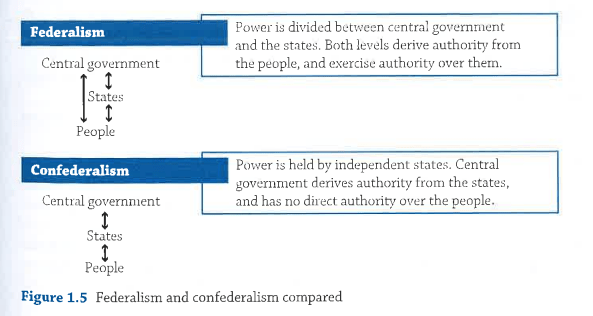
For this reason, the term federation could also be applied to the European Union. It acts as a federalist system, having a central authority (not a government) which acts directly both on national governments and on the citizens themselves (See Figure 1.5). Federalist characteristics of the EU would be its Multi-level Governance system, the prevalence of its laws over national laws, its directly elected parliament system, and its common currency for most member states.
owever, a distinction could be added, as other elements tend to qualify the EU as a confederation rather than a federation. In fact, it does not fully impact its citizens directly, but relies on national governments for some of its competences. States remain sovereign, and their citizens still report to them individually. The lack of a common tax policy and military creates a distance between people and the EU institutions, while granting states a greater allegiance from their nationals.
In history, no full confederation has ever existed. The closest countries to it would for instance be Spain or the United Kingdom, whose internal subdivisions hold enough autonomy to be considered as confederate members, but are still not powerful enough to have this status.
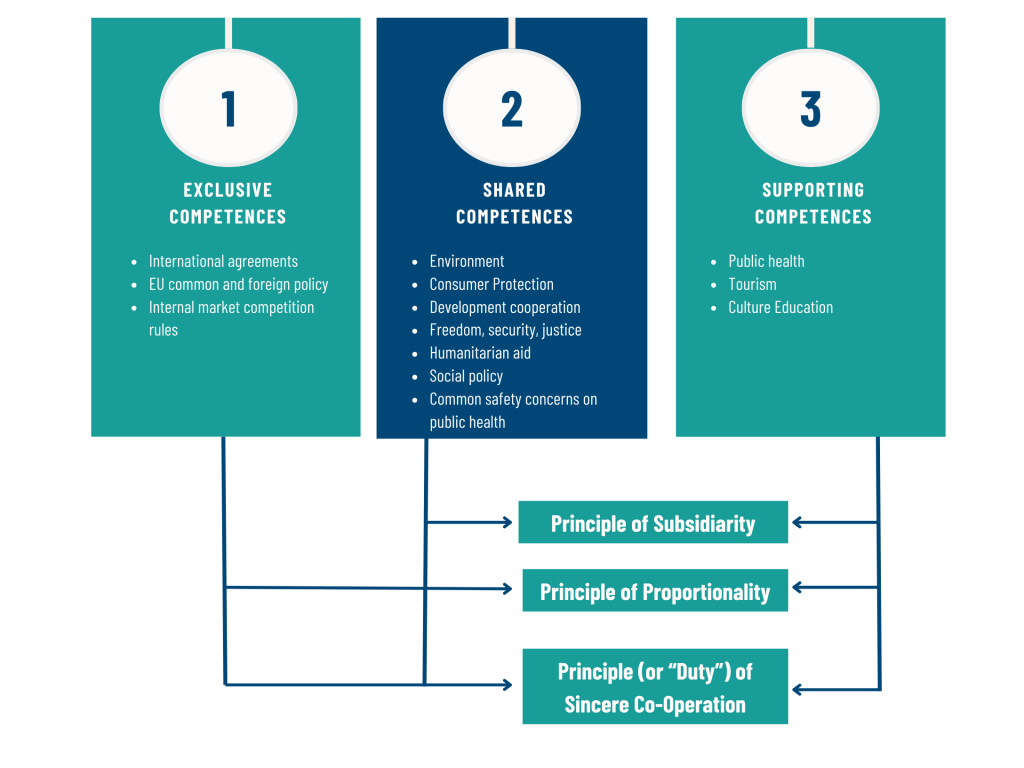
The EU holds an incredible amount of exclusive and shared competences with its member states : a common customs union, exterior commercial policy, single market and monetary policy is applied to the 27 states, with the EU being also highly involved in the areas of agriculture, environmental policy, transport and energy, and social policy.
In fact, nothing comparable to the European Union has ever come to existence. A continent uniting itself and suddenly deciding to march together towards progress is unprecedented, especially after centuries of constant war between its states. Currently, organisations like the ASEAN and the African Union have tried to build up such a strong unity around brotherhood, but the first one acts solely on economic matters, and the second one remains shattered by the deep rivalries within its own members. To define a phenomenon, one would normally need several examples of it, in order to create a comparison and to regroup enough elements for it to become a category in itself. The EU stands alone, and hence it is the “patient zero” for such a concept. Furthermore, it is a moving object, and changes very regularly, with new treaties being signed every 10 years, each one altering more or less the system, and adding complexity to it.
The hybridity of the EU acts as an advantageous compromise solution for all of its member states, keeping certain competences while delegating others to a superior authority, acting for the common good of all European citizens. Unfortunately, the system has turned out to be rather difficult to fully comprehend, and is not really easing the legislative processes for all states.
Some would rather have a European Union that gives up power and restores it to the states, following the nationalism wave that we are experiencing currently. Populist parties make use of the sole existence of the EU as a reason for all of Europe’s problems.
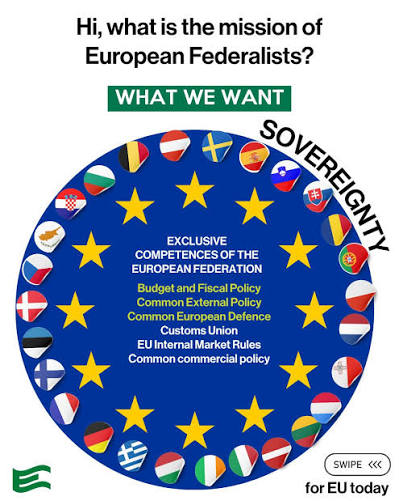
Others are pushing for a more federal union, like the Union of European Federalists. Possessing considerable influence, this supranational organisation is pushing for a clear definition of its own protected competences both on European and national levels, in a system that would work similarly to the United States of America. The EU, in a Federal Union, would not surrender competences to the states, neither would the states to the Union.
The confrontation of both visions sparks active debates on the need to reshape the European Union, to make it less complex, more competitive, and more powerful on the global scene. What many seem to agree on, is that a new reform is needed for the EU, to counter the growing euroskepticism and aliment brotherhood among nations.
– Esteban Fleury
Sources :
McCormick, John (2025) : Understanding the European Union. A concise introduction. 9th edition, Bloomsbury Academic, London


Votre commentaire